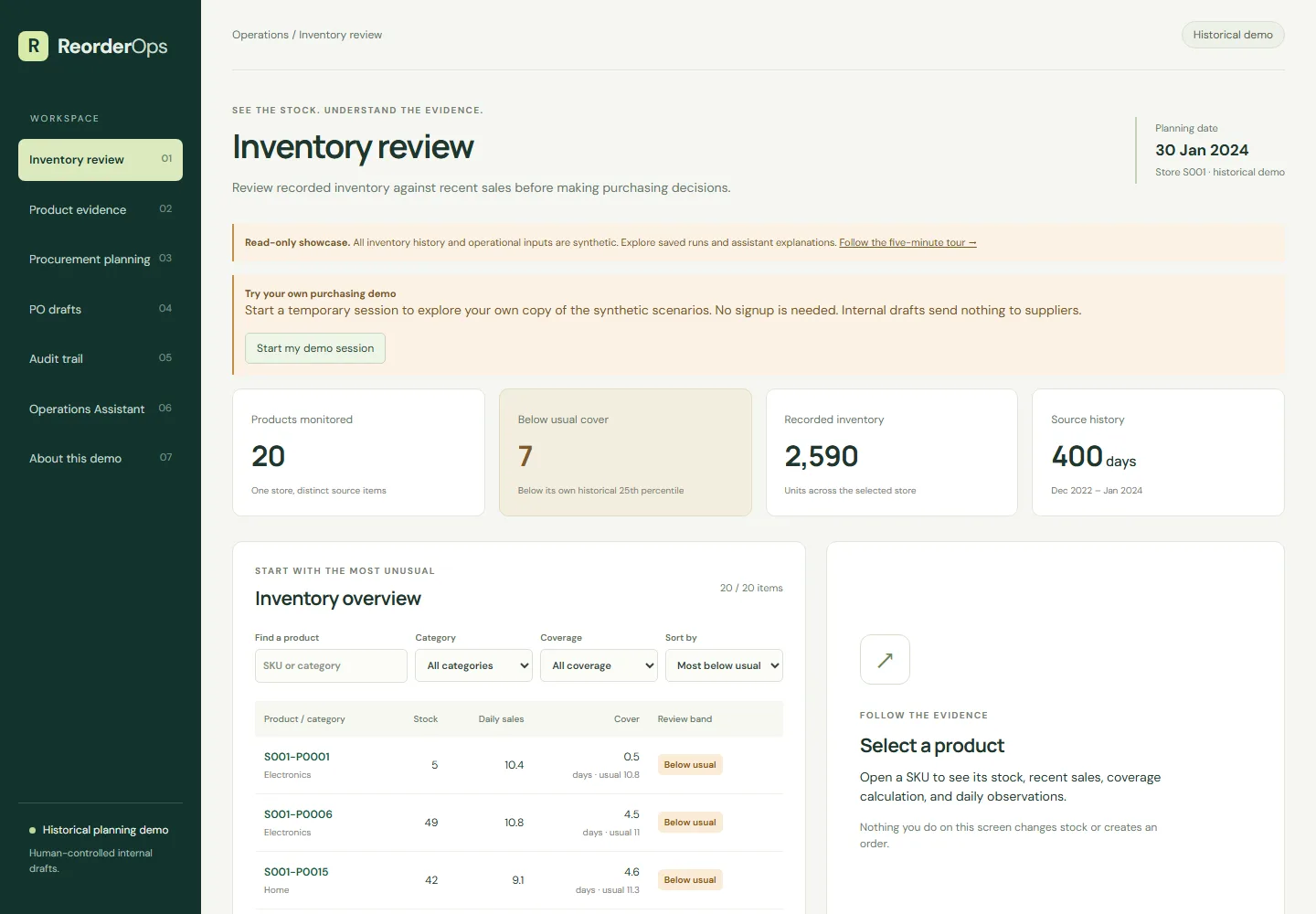
The problem
An inventory planner needs to understand which products need attention, why they need attention, and what action is safe to review. Low stock alone is not an order instruction: incoming supply, lead times, demand changes and supplier constraints all matter.
The first historical review used fixed coverage bands. Those bands were noisy on the source data. Product-relative percentiles improved context, but historically usual stock can still be insufficient for a supplier’s lead time. Procurement planning became a separate deterministic calculation.
Planning that can be replayed
Pure business rules project stock and calculate replenishment using supplier lead times, safety stock, minimum orders and pack sizes. Saved runs preserve the inputs, engine version and business-input fingerprint, rather than silently recalculating old evidence.
- FILTER-420: 210 units recommended, with expediting review for the earlier shortage.
- VALVE-88: a raw requirement of 75 becomes 120 under the supplier minimum.
- BELT-210: timely inbound prevents a duplicate order.
- BEARING-51: a demand anomaly holds the recommendation for review.
A human decision, validated again
Approval rereads current stock, inbound, demand and supplier terms inside a short SQLite write transaction. Changed evidence blocks the action. Exact retries return the original result; uniqueness constraints prevent a second active draft for the same product.
Internal purchase-order drafts send nothing to a supplier and do not become confirmed inbound. Successful and blocked actions enter an append-only audit trail. Direct file or schema access can still tamper with SQLite; this is not a claim of tamper-proof storage.
AI interpretation with a narrow boundary
The GPT-6 Luna integration uses controlled read-only tools to retrieve detached evidence and link verified cards to the application. Authoritative quantities belong to the backend. The assistant cannot approve, create drafts, edit stock or submit orders.
Evaluations include multilingual questions, messy input and prompt-injection attempts. They exposed a useful limitation: correct evidence references do not guarantee sound prose or the requested language. Deterministic fallback preserves useful evidence when the provider fails or reaches a quota. AI explanations still require review.
A public demo with isolated actions
The Vercel frontend and Railway backend present generated history, rather than the private CSV whose provenance and license remain unverified. Visitors receive separate temporary database copies so their drafts and audit events remain isolated.
A persistent control ledger reserves estimated AI spending before a provider call and applies usage limits. Uncertainty retains the reservation. These are cost controls, not a claim of measured operating savings.
Verification and honest limits
Tests cover missing and malformed data, calculation boundaries, saved-run replay, stale approvals, transaction rollback, concurrency, visitor isolation and recovery. The documented v1.4 milestone reports 303 backend tests passing across Python 3.11 and 3.12, with Ruff and frontend checks.
Recorded hosted checks cover purchasing and bounded AI behavior. Language reliability, provider-usage reconciliation, full production recovery and cold-start timing remain qualified. The project has no live ERP integration, supplier submission, receipt workflow, anomaly override or real-account authentication. It demonstrates engineering decisions, not measured forecasting accuracy or retail savings.
Verification record
- Automated checks cover malformed inputs, replay, concurrency, rollback, stale approvals and visitor isolation.
- Multilingual, messy-input and adversarial AI evaluations retain observed semantic and language failures.
- The recorded planning-v1.4 milestone reports 303 backend tests passing on Python 3.11 and 3.12, plus Ruff, TypeScript and production-build checks. This is source evidence, not a test count for this portfolio.
Documentation
For a deeper engineering review, read the curated reviewer guide, architecture, planning rules, AI evaluation and public-demo controls. These technical documents are available in English.
DocumentationDocumentation status
Forthcoming evidence
- A narrated walkthrough video may be added.
Source material
This presentation is grounded in the following project material.
- ReorderOps README.md
- docs/portfolio-case-study.md
- docs/reviewer-guide.md
- docs/v5-live-evaluation-expanded.md
- docs/v6-hosted-ai-evaluation.md
- docs/public-demo-controls.md
Documentation · English